Transportation
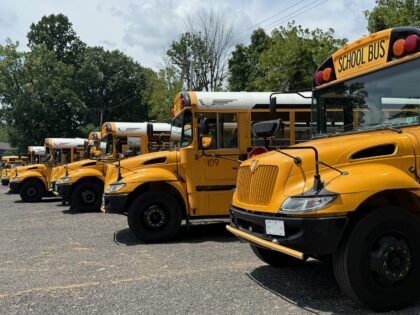
As a parent of a day camp child you will most likely have many questions concerning the transportation program in camp. This page has been created in hopes of clarifying ARROWHEAD DAY CAMP’S transportation program. It will answer many questions, provide you with information and allow you to become better acquainted with this phase of our camp program.
We personally oversee all aspects of our transportation operation – including routing, vehicle maintenance and staffing. Our entire transportation service is designed with one purpose in mind – to give each child the safest and most efficient ride to camp. We never lose sight that we are transporting very precious cargo – your children! Safety is always our primary concern.
Click on the titles below to learn more.
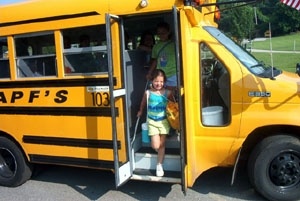 Our buses are maintained and inspected regularly during the school year. Just prior to the start of the summer there is a thorough service provided for the entire fleet. This inspection includes all maintenance records, daily driver inspection reports, and driver records. There is a mechanic on call for the leased buses. Preventive maintenance is the key to our vehicle safety program, and we practice it at all times. All private passenger vans will have the latest PA state inspection sticker.
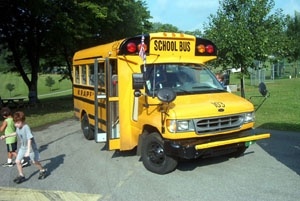 Seat belts are not required by the State of PA. on conventional school buses. Safety studies have shown seat belts on the larger school buses tend to be more of a hindrance than an asset in case of an accident or emergency. Our school mini vans and private passenger cars are equipped with seat belts and capacity on these vehicles never exceeds the number of seat belts available. You can help us by reminding your child to stay in his/her seat and to use the seat belts at all times.
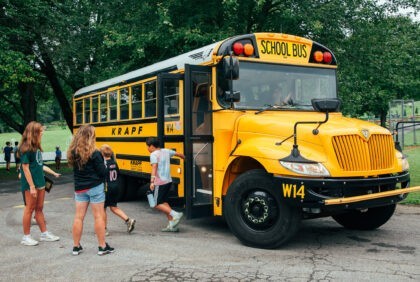 Riding the camp bus is fun – it is different – and it is a very definite part of camp! Our philosophy is based on the fact that the camp day begins when your child enters the vehicle and not when he/she arrives at camp. Each morning as your child enters our vehicles there will be greetings by the driver, supervisor and camp friends. While on the vehicle your child will have an opportunity to meet new friends and share camp experiences. This is a very valuable extension of the camp day. Please allow your child to enjoy this experience by reinforcing and inspiring positive thoughts about the ride to and from camp.
 Any time you desire a scheduling change you must contact the office. All changes must go directly through the office and not the driver. All requests must be in writing and approved in advance by the camp. Phone requests will not be honored. This is for your child’s protection! If your child is sick the night before or the morning of camp, please call the driver immediately. Please do not call the camp for absenteeism. Prior to your child starting camp, the driver will contact you in person at home. This information will provide you with the driver’s name, vehicle ID and pick up and drop off times. If the driver does not make contact, please call our office the week before your child begins camp. Once the route is established please keep your AM and PM conversations with the driver to a minimum. Your driver has many children to pick up and lengthy conversations with several parents along the route can cause a vehicle to be as much as 30 minutes late.
 Campers are assigned to a specific route and vehicle at the onset of the summer. In an attempt to shorten and modify routes the transportation director may elect to reassign your child to another vehicle. Usually this change occurs within the first 2 weeks of the summer based on the need to change a route or add a vehicle. Two weeks is the average time required to stabilize a route due to adjustments and our never ending effort to minimize travel time. You are reminded that once a child is assigned to a vehicle that he/she is not allowed to randomly switch to another vehicle. We are limited in seating capacity and we do not wish to confuse either the camper or the driver of the routes that are involved. When there is a divorced family situation we cannot provide pick up and drop off at alternative homes
Due to available space on the vehicles, we do not allow children to go home or be picked up on a different vehicle. If the camper must leave camp early, it is the parent’s responsibility to make arrangements for early pick up. This is done by sending in a note in advance to the office identifying the camper and the time of pick up. All campers must be picked up by 3:00 PM or they will be sent home on their vehicle. If you are dropping your children off at camp in the morning, no child will be admitted before 9:30 AM. Arrowhead does offer drop- off and pick up service from the hours of 7:30 A.M. to 5:30 P.M. We provide supervision and activities for those campers electing this option. It is limited in space and must be consistent A.M. and P.M. throughout the entire season. Please feel free to call us for further details.
- Stay on the curb or sidewalk until the vehicle arrives.
- Wait until the vehicle comes to a complete stop before you approach it.
- When crossing a street to board your vehicle or after leaving your vehicle, wait until the driver or counselor checks the traffic for you and then allows you to cross.
- Always stop, look and listen before crossing any street when going to or leaving the vehicle.
- Never chase the bus or any vehicle.
- Once seated in the bus, do not change seats.
- Always wear your seat belt (if applicable).
- Do not get out of your seat to depart from the vehicle until it has come to a full stop.
- Talk quietly with your friend, do not yell in the vehicle.
- Do not put your arms or head out of the window.
- Never throw anything out of the window.
- Sit with your back against the seat at all times.
- Do not sit on your knees or turn around at any time.
- iPods, cell phones, electronic games and toys are not to be brought to camp or allowed on the vehicle at anytime.
- Follow all directions from the driver and the counselor.
- Remain seated at all times.
- Enjoy your ride to camp!
It is our hope that this informational page has given you a better understanding of our transportation program. We will be most delighted to discuss our transportation service with you in greater detail if you have the need. We look forward to providing you and your child with an excellent transportation experience for the coming summer.
In the interest of SAFETY, we at ARROWHEAD answer your question as to “WHY… SCHOOL BUSES DON’T HAVE SEAT BELTS?”
It seems counter to common sense. If we’re buckling up for safety in our cars, shouldn’t the kids be buckled into their bus seats, too? The answer is no, says the Pennsylvania School Bus Association. Unlike the family car, which carries passengers low to the road and in the same plane as a colliding vehicle, a school bus carries its riders above the impact zone and away from the engine. School buses are designed to carry kids somewhat like eggs in an egg crate – that is, each seat serves a separate padded compartment. The design prevents the seated child from being tossed about, in or out of the bus. Crash tests conducted by the Canadian Department of Transportation found that dummies wearing seat belts on buses actually received higher injury scores than unbelted dummies. The reason: The crash forces were spread out over large areas when the unbelted body struck the rear of the seat in front. Belts caused the dummies to pivot, so that the brunt of the impact was sustained in the head and neck areas. The most dangerous place for a school bus-riding child, says the association, is within 10 feet outside the bus … where they are struck by cars that fail to stop.
To read even more information regarding school buses, seat belts and safety click here.